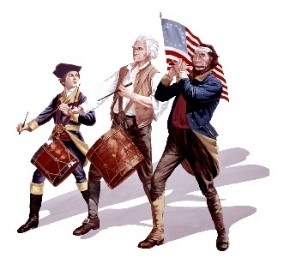
In the mid-west town of Wellington, Ohio, near the intersection of Ohio routes 18 and 58, at what the locals call the center of town, at 201 North Main Street, is a store front, which years earlier manufactured cheese of notable reputation, and now houses the Spirit of ‘76 Museum. The Spirit of ’76 Museum provides the community with over 4,000 artifacts, from the days of the Cheese Industry in Wellington to Archibald Willard’s painting of The Spirit of ’76. But in addition to the displays of local interest, including school yearbooks and photographs, women’s and gentlemen’s clothing, the museum displays much of the Wellington and regional life artifacts of farm and home.
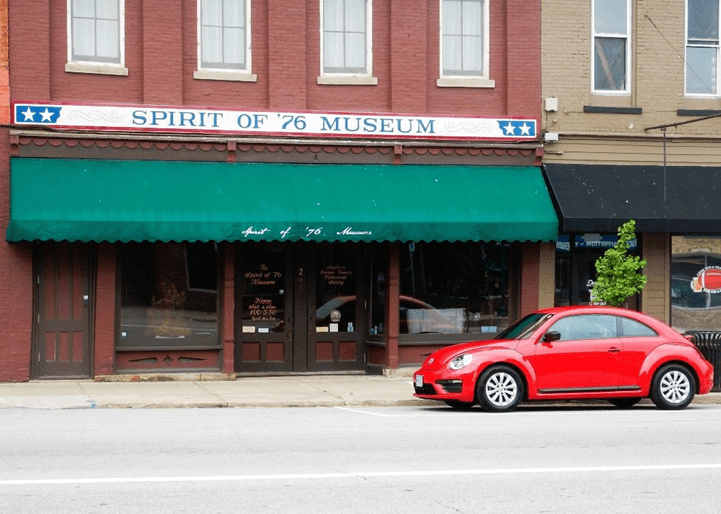
The Spirit of ’76 Museum front on Main Street, Wellington, Ohio.
Of course, the center of interest and as in our case, the first thing seen on a tour of the museum is an original oil painting of the now famous work by Archibald Willard, The Spirit of ‘76. A painting which adorns a prime position along the walls of the main gallery on the first floor.
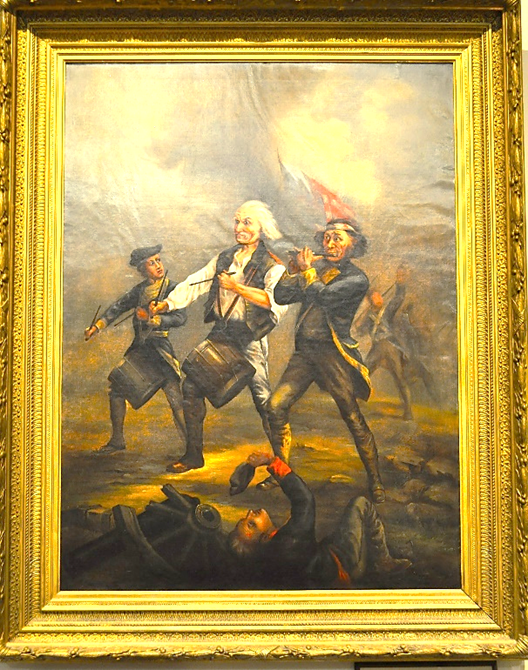
The Spirit of ’76, originally titled Yankee Doodle, was painted by Archibald M. Willard (1836-1918), for exhibit in Philadelphia during the 1876 centennial celebrations.
The painting on the wall of the Spirit of ‘76 Museum is but one of several originals, each original with minor variations in subtle color changes, or minor alterations of the characters military outfits, and perhaps many others not yet fully documented. Susan and I spent a few minutes looking carefully at the several other reproductions of The Spirit of ‘76 held by the museum, to see if we could spot some of the subtle changes in color or minor alterations. We were hard pressed to do so. We had other reasons to visit the museum on that Sunday, June 2, 2024.
Earlier we had made contact, via emails, with the Secretary of the Spirit of ‘76 Museum, Ms Karen S. Wright. We noted our interest in studying and photographing the vertebrate fossil bones which we had observed in an earlier visit to the museum back in 2013. We wrote that the fossils might have scientific value and perhaps Ohio paleontologists, especially those concerned with vertebrate animals, might enjoy seeing some of these specimens for themselves.
Ms Wright invited us to visit the museum and meet with Cindy Norton, a Spirit of ‘76 Museum Board Member and knowledgeable person about such collections, especially those of John Alexander Justice (ca.1838 – 1926), of Brighton Township, Ohio, whose collections are housed at the museum.
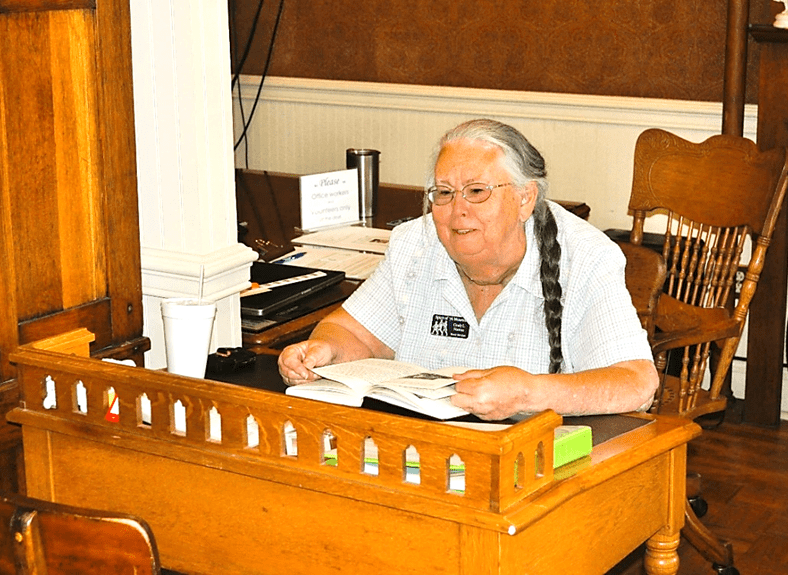
Cindy Norton, Board Member of the Spirit of ‘76 Museum at work.
Once Susan and I were acquainted with Cindy, we were impressed with the depth of background and excitement with which she approached her task of showing us about the three floors of the beautifully displayed artifacts and information surrounding the many objects on display at the museum. Ms. Norton knew of our interest in the collections made by the pioneer woodsman Justice as eventually we ended up on the third floor of the museum and were immediately astounded by the number of objects, the complexity of the displays and the diversity and completeness of materials on display. All what we saw in the room was collected by or fabricated by Alex Justice!
Ms Norton explained to us that inasmuch as Justice was a man who lived alone, perhaps a true hermit or recluse, everything in the room was either collected by Justice, or made by Justice, including his clothes, dishes, tools, and so many other artifacts too numerous to list here.
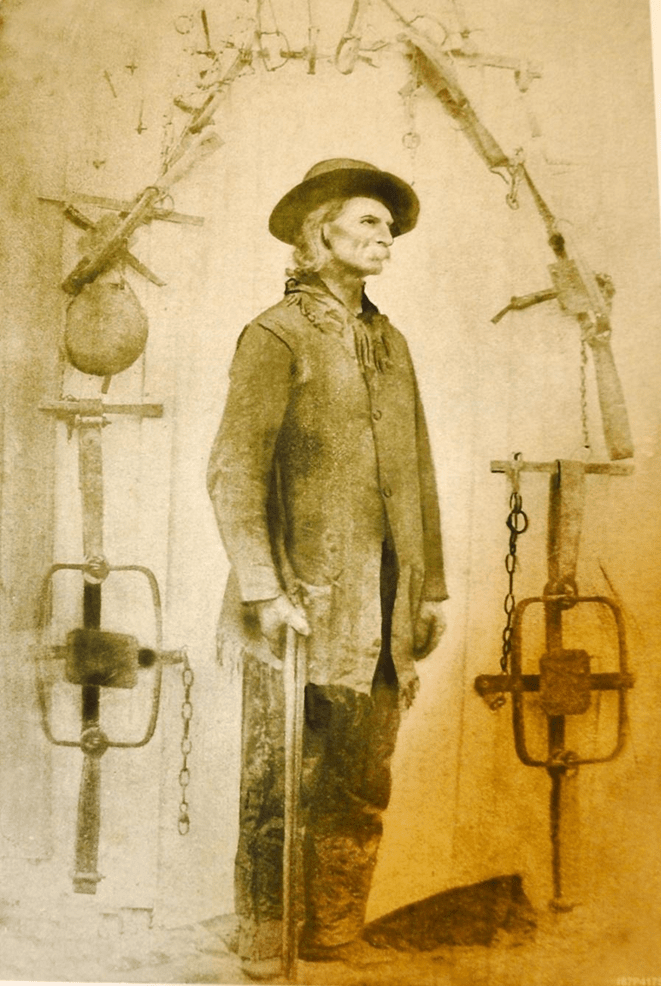
Alex Justice as seen in his “scouting” outfit. The outfit is on display at the Spirit of ‘76 Museum.
` Justice travelled throughout the Western Reserve in Ohio and walked alone from Ohio to Florida on several occasions, collecting native American artifacts and bones from extant or extinct animals (Hines 2003). Many of the vertebrate bones collected by Justice are of recent mammals, including a fine specimen of a bear scull. The image shown below titled by us as “The Justice Corner” shows some of the material items which Alex Justice manufactured for his personal use.
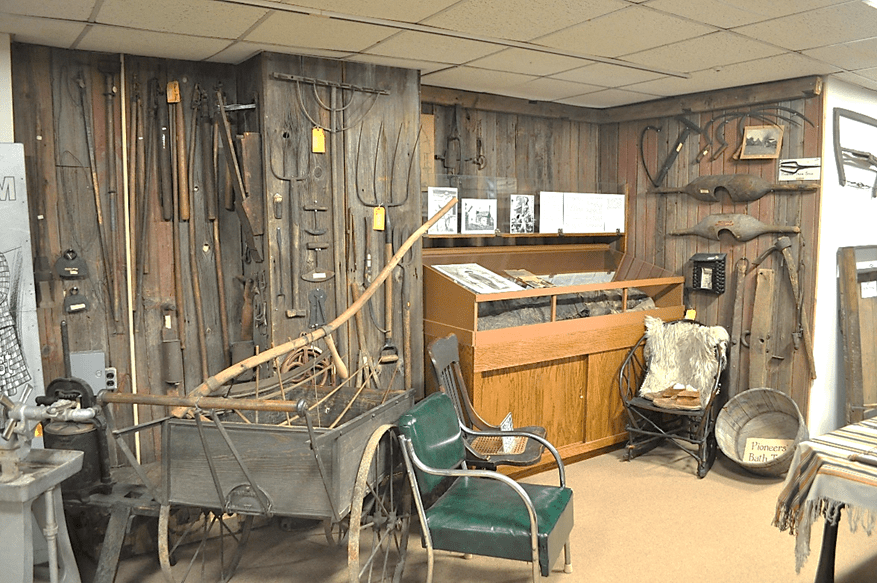
The Justice Corner of the Spirit of ‘76 Museum. Note the manufactured (by Justice) farm tools adorning the wall. This area truly displays the spirit of Alex Justice.
Cindy Norton noted that some data may be available as to the origin of these bones and other materials, however, the data are scarce and difficult to associate with a specific collection. Regardless of this lack of completeness, the collections made by Justice have a historic value and, in our opinion, may serve as valuable additions to a local zooarchaeological collection, useful to primary or secondary schools. Alex Justice died in 1926 at the age of 88 and buried in a casket he made himself. He is interred in Section D of the Brighton Township Cemetery. Hearing of the tales of Alex Justice, I was reminded of the travels of William Bartram who travelled on foot in the southeastern United States throughout Florida, Georgia the Carolinas and even partially into states adjacent to the Florida panhandle (Porter, 1992). Perhaps he and Justice crossed paths.
One fossil specimen which attracted our attention was a single rather large molar of a Mammoth. The specimen was hand-labeled as Mastodon tooth; however, this was clearly that of a Mammoth. I showed Cindy the pages in the book Fossils of Ohio (Feldmann & Hackathorn, eds.,1996) covering the presence of Mammoths and Mastodons in Ohio and showed her the illustrations of the respective tooth batteries. Ms Norton agreed that the specimen was mislabeled and would soon make the necessary change.
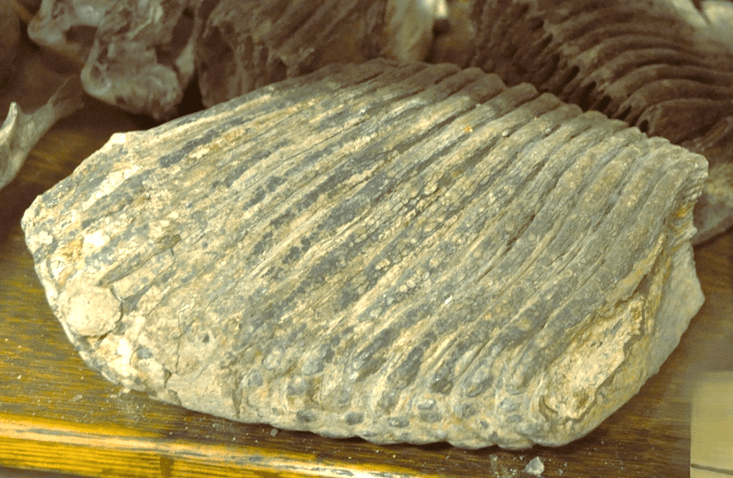
The grinding surface of a Mammoth tooth on display at the Spirit of ’76 Museum. The specimen appears somewhat flattened.
Individuals or families are encouraged to see for themselves the holdings of the Spirit of ‘76 Museum in Wellington. Perhaps several visits would be needed to properly absorb the many exhibits and details accompanying each of the artifacts on display. The feeling of being an American comes forward as one travels through the Museum. The Willard painting, the tribute to our armed forces and the remembrances of local Ohioans stir the imagination and bring a feeling of pride to be an American and especially one living in Ohio.
Susan and I thank the Board of the Spirit of ’76 Museum for their work and cooperation in allowing us to have free access to the collections at the museum. We especially thank Ms Cindy Norton for her exciting nature and enthusiasm in taking us on a walk through history.
References
Feldmann, R.M. and Hackathorn, Merrianne, eds. 1996. Fossils of Ohio: Ohio Division of Geological Survey Bulletin 70, 577 p.
Hines, Cheryl Ewell. 2003. Brighton Township, Ohio: Where the Pioneer Souls Live On. Published by the author. Printed by Express Publishing, Mansfield, Ohio. 216 pp.
Porter, Charlotte M. 1992. Philadelphia Story: Florida Gives William Bartram a Second Chance. Florida Historical Quarterly Vol. 71:(3).
https://stars.library.ucf.edu/fhq/vol71/iss3/5
Website for the Spirit of ‘76 Museum: https://thespiritof76museum.org/
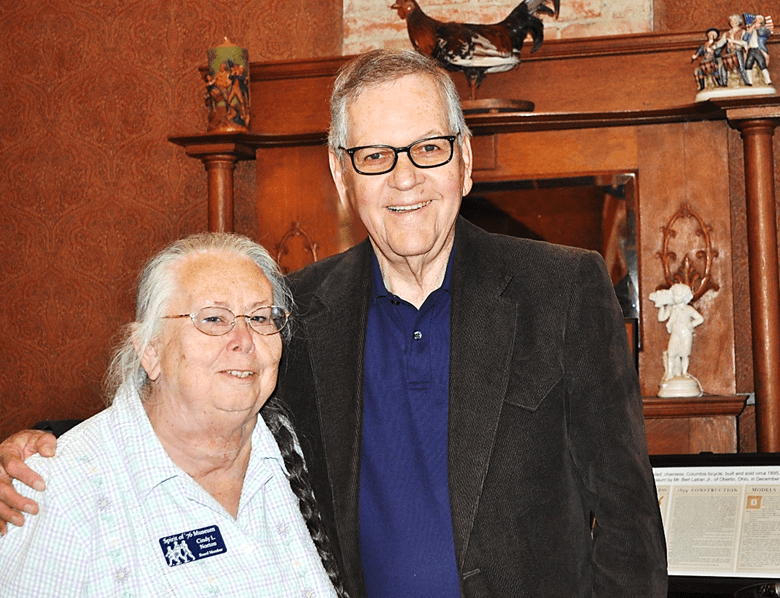
Cindy Norton and David M. Jarzen at the Spirit of ‘76 Museum
Wellington, Ohio, June 2, 2024.
David M. Jarzen, Ph.D.
Susan A. Jarzen, CAP
June 3, 2024
 The Spirit of '76 Museum